vendredi 6 décembre 2013

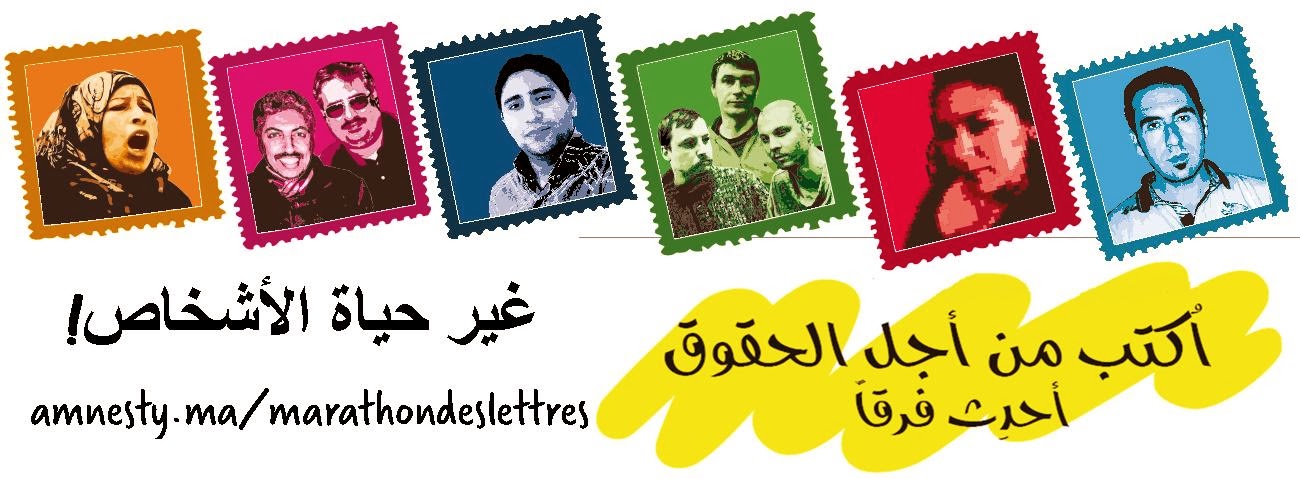
أُكتب من أجل الحقوق - مليونا رسالة وتغريدة ورسالة نصية لتغيير حياة الأشخاص

                                
حملة "أكتب من أجل الحقوق" واحدة من الحملات العالمية الكبرى لمنظمة العفو الدولية. وفي هذه الحملة ستتم تعبئة مئات الآلاف من الأشخاص حول العالم من أجل تغيير حياة الأفراد المعرضين للخطر من خلال القيام بنشاط بسيط، وهو إرسال رسالة.

ففي الفترة من 6 إلى 17 دجنبر، سيقوم أشخاص من أكثر من 80 بلداً في شتى أنحاء العالم بحملة من أجل 12 فرداً ومجتمعاً يعانون من انتهاكات حقوق الإنسان. وسيقوم المشاركون في الحملة بالإشارة إلى الحكومات المسيئة بالاسم وتحميلها المسؤولية المشينة عن الانتهاكات ومطالبتها بمساعدة الذين يعانون من قمع الدولة.

وتتوقع منظمة العفو الدولية أن يتم إرسال أكثر من مليوني رسالة وفاكس ورسالة إلكترونية وتغريدة ورسالة نصية خلال مجرى الحملة.

وقال سليل شتي، الأمين العام لمنظمة العفو الدولية: "إن حملة الكتابة من أجل الحقوق تعتبر مبادرة رئيسية، تتجه مباشرةً إلى صلب عمل منظمة العفو الدولية، وهو التحرك دفاعاً عن الآخرين، وإظهار التضامن مع أولئك الذين يقفون بشجاعة ضد الظلم."
فمن الجزائر إلى سلوفينيا، ومن هونغ كونغ إلى المغرب، ستُنظم سلسلة من الفعاليات لترويج القضية، ومن بينها الحفلات الموسيقية، وفن الرسم على الجدران (الغرافيتي)، وكتابة الرسائل على مدى 24 ساعة.

وسيركز الفرع المغربي على 6 حالات تمتل طيفاً واسعاً من قضايا حقوق الإنسان المختلفة.
v     محنة سكان قرية نبي صالح الفلسطينيون:
سيقوم الفرع المغربي أيضا بتسليط الضوء على محنة سكان قرية نبي صالح الفلسطينيون الذين يرزحون لحصار فعلي من قبل المستوطنين الإسرائليين، ويواجهون قمعا مستمرا لأنهم يتظاهرون في كل يوم جمعة ضد الإحتلال الإسرائيلي.

v     تدعو منظمة العفو الدولية-المغرب إلى إطلاق سراح سجناء الرأي في ثلاثة بلدان مختلفة:
·         13 مدافعاً عن حقوق الإنسان في البحرين حُكم عليهم بالسجن لمدد تتراوح بين خمس سنوات والمؤبد بسبب التعبير عن آرائهم ونضالهم السلمي.
·         المدون التونسي جابر الماجري الذي سجن لمدة تزيد على سبع سنوات بتهمة "المس بالمقدسات" و"الاخلال بالآداب العامة"، إثر نشره آراء تتعلق بالدين على مدونته.
·         النشطاء الروس الثلاثة، الذين سُجنوا إثر احتجاجات السلمية في ميدان بولوتنيا، واتُهموا "بالمشاركة في أعمال شغب جماعية".
v     تقوم منظمة العفو الدولية-المغرب بحملة من أجل شخصين جرَّمتهم الدولة:
·         تعرضت ربة المنـزل المكسيكية مريام لوبيز للتعذيب والاغتصاب من قبل ضباط في الجيش، وأُرغمت على توقيع إفادة تقر فيها بأنها متورطة في الاتجار بالمخدرات.
·         تعرَّض السائق التركي هاكان يمان للضرب الوحشي وقُلعت إحدى عينيه على أيدي الشرطة التركية خلال الاحتجاجات التي اندلعت في هذا العام.

وتجدر الإشارة إلى أن مراثون الرسائل من أجل الحقوق يعتبر تظاهرة للتضامن الأممي. كما أن له تأثيراً إيجابياً قوياً على حياة الأفراد الذين تتعرض حقوقهم الإنسانية للخطر. إذ أن من السهل تجاهل رسالة واحدة موجهة إلى السلطات، ولكن من الصعب تجاهل آلاف الرسائل التي تطالبها بإجراء تغييرات في أوضاع حقوق الإنسان. إننا نعرف من خلال النضال الذي استمر عقوداً أن كتابة الرسائل يمكن أن تنقذ أرواحاً وأن تغير حياة بشر.

خلفية
لقد حققت حملة الكتابة من أجل الحقوق، منذ بدئها، نتائج ملموسة في مجال إطلاق سراح سجناء الرأي. ففي 22 نونبر من هذا العام، اي قبل إطلاق الحملة رسمياً ببضعة أيام، أُطلق سراح الناشطة الكمبودية من أجل حقوق السكن يورم بوفا بكفالة.
وبعد أيام قليلة من لمِّ شملها مع عائلتها ومجتمعها المحلي، كتبت إلى منظمة العفو الدولية تقول: "شكراً لأنصار منظمة العفو الدولية، لقد تكلَّلت حملتكم بالنجاح مثلما يُظهر إطلاق سراحي! ولكن قضيتي لم تنته بعد. أرجو مواصلة دفع الحكومة الكمبودية إلى إنهاء الدعوى القانونية المرفوعة ضدي. وأرجو مساعدتي ومساعدة مجتمعي وعدد من الأشخاص الآخرين في كمبوديا! يمكننا تحقيق أقصى النجاح إذا عملنا جميعاً معاً!"
أما بالنسبة للأشخاص الذين مازالوا يقبعون في السجن، فإن رسائل الدعم لا تُقدر بثمن:
"لقد غمرني سيل من الرسائل والبطاقات البريدية. وقد قضيت عطلة رأس السنة في قراءة مئات الرسائل والبطاقات البريدية. ويمكنني أن أقول بصدق إنني لم أفوِّت رسالة واحدة منها"- أليس بيالياتسكي، مدافع عن حقوق الإنسان يقبع في السجن في بيلاروس.
وللمزيد من المعلومات حول الحالات المتبناة للعمل، يمكنكم زيارة الموقع المخصص للتحرك في إطار هذه الحملة على الرابط: www.amnesty.ma/marathondeslettres

منظمة العفو الدولية - المغرب

lundi 25 novembre 2013

DE LA PAIX CHEZ SOI À LA PAIX DANS LE MONDE: “Défions le militarisme et finissons-en avec la violence faite aux femmes”,


Amnesty international lance sa campagne 16 jours d’Activisme Contre la Violence Liée au Genre” le 25 Novembre 2013, en partenariat avec le Centre pour le Leadership Mondial des Femmes (CWGL), sous le slogan « De la paix chez soi à la paix dans le monde, défions le militarisme et finissons-en avec la violence faite aux femmes »

La campagne des « 16 jours d’Action contre la Violence Liée au Genre » est une campagne mondiale qui vise à mettre fin à la violence contre les femmes. Cette campagne est organisée chaque année durant la période allant du 25 novembre, Journée internationale pour l'élimination de la violence à l'égard des femmes, et le 10 décembre, la Journée Internationale des de l'Homme. Ces dates font le lien symbolique entre la violence contre les femmes et les droits de l’homme pour souligner qu'il s'agit d'une violation des droits de l'homme
La campagne des 16 jours pour cette année met en évidence le lien entre la violence contre les femmes et le militarisme. Celui-ci constitue une source majeure de la violence contre les femmes. C'est une idéologie qui incite à une culture de peur et qui soutien le recours à l'agression, à la violence et à l'intervention militaire pour satisfaire des intérêts économiques et politiques. Cette idéologie est basée sur certaines formes de masculinité qui suppose que la violence est un moyen efficace pour résoudre les problèmes militaires. Cette idéologie a souvent des conséquences néfastes sur la sécurité et la sûreté des membres de notre société, que ce soit celle des enfants, des femmes, ou même des hommes.                                                                                                          
Dans ce contexte, Amnesty International saisit l'occasion de la Journée internationale pour l'élimination de la violence à l’égard les femmes, cette année, pour renouveler son appel au gouvernement marocain :

§ Révision et harmonisation des lois relatives aux femmes et leur adéquation avec la convention internationale sur l’élimination de toutes les formes de discrimination à l’égard des femmes et ratification du protocole facultatif s’y rapportant et les mettre en œuvre sans aucune réserve.

§ Ratification du Statut de Rome de la Cour pénale internationale et des  législations nationales pour mettre fin à l'impunité pour au sujet de la violence contre les femmes pendant les conflits armés.

§ Adoption du sur “traité international du commerce des armes” afin d’arrêter la prolifération les armes utilisées pour violenter la femme.

§ Promulgation et application de lois protégeant la femme. Aussi, considérer que la violence dans le contexte familiale est semblablement grave à tout autre contexte de violence.

§ Faire face à l’appauvrissement des femmes en garantissant leur égalité avec les hommes dans les droits sociaux et économiques, y compris l’accès à l’eau, à la nourriture, au droit du travail et à la propriété, et aux droits sociaux tout en veillant à leur sécurité sociale surtout en période difficiles et de crises économiques.

Pour plus d’informations sur les cas adoptés par Amnesty International-Maroc veuillez consulter le lien consacré à cette compagne : www.amnesty.ma/16jours


Amnesty International-Maroc

من السلام في المنزل إلى السلام في جميع أنحاء العالم: حملة 16 يوما لتحدي الفكر العسكري والعنف ضد المرأة


تطلق منظمة العفو الدولية » حملة 16 يوما من التحرك لمناهضة العنف على أساس النوع الاجتماعي « يوم 25 نونبر2013 بتنسيق مع مركز القيادة العالمية النسائية (CWGL)، تحت شعار "من السلام في المنزل إلى السلام في جميع أنحاء العالم: لنتحدى الفكر العسكري ونضع حدا للعنف ضد المرأة".
"حملة 16 يوما من التحرك لمناهضة العنف على أساس النوع الاجتماعي" هي حملة عالمية مكرسة لإنهاء العنف ضد المرأة. وتنظم هذه الحملة كل سنة في الفترة مابين 25 نونبر، اليوم العالمي لمناهضة العنف ضد المرأة، و 10 دجنبر، اليوم العالمي لحقوق الإنسان. وهذه التواريخ تربط رمزيا العنف ضد المرأة وحقوق الإنسان للتأكيد على أنه انتهاك لحقوق الإنسان.
تسلط حملة 16 يوما لهذا العام الضوء على تقاطعات العنف ضد المرأة والفكر العسكري. حيث أن هذا الأخير يشكل مصدرا رئيسيا للعنف الذي تتعرض له المرأة. فهو كإيديولوجية يخلق ثقافة الخوف ويدعم استخدام العدوان والعنف والتدخل العسكري من أجل وضع تعزيز المصالح الاقتصادية والسياسية على حد سواء. وتركز هذه الإيديولوجية على أشكال معينة من الذكورة التي تفترض أن العنف هو وسيلة فعالة لحل المشاكل العسكرية، وغالبا ما تكون لهذا الفكر عواقب وخيمة على سلامة وأمن مجتمعنا ككل بما في ذلك الأطفال والنساء وكذا الرجال.
وفي هذا الإطار،  تغتنم منظمة العفو الدولية فرصة اليوم العالمي لمناهضة العنف ضد المرأة هذه السنة لتجدد دعوتها للحكومة المغربية إلى مايلي:
  • مراجعة القوانين المحلية ذات الصلة بالمرأة وملاءمتها مع الاتفاقية الدولية الخاصة بالقضاء على جميع أشكال التمييز ضد المرأة مع التصديق على البروتوكول الاختياري الملحق بها وتنفيذهما دون تحفظات.
  • التصديق على نظام روما الأساسي للمحكمة الجنائية الدولية والتشريعات الوطنية اللازمة لوضعه موضع التنفيد من أجل نهاية الإفلات من العقاب على العنف ضد المرأة في الصراعات المسلحة.
  • المصادقة على "معاهدة دولية لتجارة الأسلحة" لوقف انتشار الأسلحة التي تستخدم في ارتكاب العنف ضد المرأة.
  • سن وإنفاذ قوانين لحماية المرأة، وضمان اعتبار العنف في محيط الأسرة مماثلا في خطورته للاعتداءات في أي سياق آخر.
  • التصدي لإفقار النساء من خلال ضمان مساواتهم بالرجال في التمتع بالحقوق الاقتصادية والاجتماعية بما في ذلك الغذاء والماء والعمل وامتلاك العقارات والحقوق الاجتماعية ومن خلال ضمان شبكات السلامة الاجتماعية وخصوصا في أوقات الشدة والأزمات الاقتصادية.
وللمزيد من المعلومات حول الحالات المتبناة للعمل وتوقيع مناشدات التحرك، يمكنكم زيارة الموقع المخصص للتحرك في إطار هذه الحملة على الرابط: www.amnesty.ma/16jours

منظمة العفو الدولية- المغرب

mardi 19 novembre 2013

Call it by its name


You have probably heard this too many times, but words do have an actual power. By naming things we give them substance, we define them according to their importance, and the meaning they’re commonly given. 

There is one word in particular that has been very present in my mind these days, maybe because I read a lot about it or maybe because it’s still considered to be useless or even discriminative.  This word is femicide.

Femicide is the murder of  woman, for being a woman, most of the time, for being a woman that d
oesn’t  completely fit to the gender roles designed  by her society, culture or tradition. At other times even the most “obedient” women are victims of an extreme desire of control that leads to the extreme act of killing. Yes, we all know killing is an extreme act but in this case, it is the top of the iceberg, it’s the most dangerous form of gender violence, practiced day after day by husbands, fathers, brothers, lovers, strangers and institutions. In many countries most of the society is part of this process, where violence against women is considered illegal but in a way legitimate.

In the laws of some countries, women are inferior to men. In Iran for instance, the va
lue of a woman’s testimony is worth half of a man’s; in Italy in 127 women in were killed by men in 2012; in South Africa, an intimate partner kills a woman in every six hours; in Guatemala, two women in average are being murdered everyday; in the US a person is sexually assaulted in every two minute. In addition, statistics show that for  women between 15 and 44, acts of violence are the first cause of death. And there is more! Every country has it’s statistics, huge numbers of women abused, raped and killed.
Everywhere on earth there is a war going on against women. “Violence doesn't have a race, a class, a religion, or a nationality, but it does have a gender” claims Rebecca Solnit, an American writer.

On the contrary to what happens with many other wars,
only few people are talking about this one. Every woman has the same right to life and to psychological and physical wellbeing. Every person, man or woman, should start to respecting these rights, everywhere in the world.

And here I come again with the power of words: only if we call it by name, femicide, it will be actually visible, counted and explained. Without the statistics no institution will take action to stop it and the voices of the women fighting for their rights will be left unheard. 

Only if we keep on talking about femicide and violence against women - with their own rightful names -the civil society and their governments will grow awareness and one day they will take a real stand against it whether it will be in a legal, political, social or attitudinal way.

So call it by its name!


Giulia Ross
Activist from Amnesty International Italy

dimanche 10 novembre 2013

La nécessaire réforme pour l’éradication de la torture en Tunisie

Cela fait maintenant plus d’une semaine que Walid Denguir, 32 ans est décédé dans des circonstances plus que troublantes.

Le jeune homme qui aurait eu un casier judiciaire assez rempli, est décédé le 1er Novembre 2013 dans un poste de police à Tunis, quelques heures seulement après avoir  été appréhendé  par des policiers pour une affaire d’usage et trafic de cannabis et association de malfaiteurs.
La famille de la victime soupçonne de suite  que la mort de Walid Denguir est due à des actes de tortures. Leurs craintes seront vérifiées dès le lendemain lorsqu’ils  auront l’occasion de récupérer le cadavre de la victime.

Les proches du défunt font alors appel à Radhia Nasraoui , célèbre activiste et présidente de l'Organisation contre la torture en Tunisie et à un photographe afin de prendre quelques photos avant que le corps de la victime ne soit enterré.


Très vite, les photos du corps ensanglanté font le tour de la planète web, les commentaires s’enchainent, les langues se délient, la polémique enfle. Pour Radhia Nasraoui, il ne fait pas l’ombre d’un doute que Walid Denguir a été torturé. « J'ai vu le cadavre avec des traces horribles, des dents cassées, le crâne comme défoncé, du sang qui s'était écoulé du nez et des oreilles Il avait une grosse bosse derrière l'oreille, et des traces bleues au niveau des poignets, des chevilles et derrière les genoux, comme s'il avait subi la torture du poulet rôti », déclare t'elle au journal français Le Monde, visiblement effarée par ce qu’elle vient de voir. Même son de cloche chez  Zied Ben Taleb, le photographe qui a pris les clichés, « Il a reçu des coups très graves, il a dû être tiré ou accroché. »

En dépit de la gravité des faits, aucune réaction n’émanera sur le champ des autorités en place. Il faudra même attendre  le lundi 4 novembre 2013, soit plus de 48 heures après les faits  pour que le ministère de l’intérieur se décide à ouvrir une enquête judiciaire et administrative pour déterminer les circonstances exactes de la mort de Walid Denguir…


Pire encore, les résultats préliminaires de l’autopsie concluront  que la mort est due à un arrêt cardiaque survenu suite à une overdose de drogues. Quant aux traces de coups ou de pratique de torture,  le même rapport précise qu’elles ont été occasionnées lors de la pratique de l’autopsie proprement dite.
Bien évidemment, ce rapport préliminaire est loin de faire l’unanimité même parmi les spécialistes. Pour Sami Abid, médecin psychiatre et addictologue, ce résultat d'autopsie est  tout simplement "faux". Dans une déclaration à l’hebdomadaire français Nouvel Observateur, il déclarera : "On ne connaît pas de dose mortelle au cannabis, sauf pour de petits animaux selon certaines études pratiquées en laboratoire sur des souris. Il existe un risque létal en cas de surconsommation chez les petits mammifères, non, d'ailleurs, par arrêt cardiaque, mais par dépression du système nerveux central...", assure le médecin, ajoutant en outre que "pour provoquer la mort d'un homme il faudrait l'ingestion d'environ 10 kg à 21 kg de cannabis selon la concentration".


Durant les années Ben Ali, la violence était courante dans les commissariats et la crainte est grande de voir ces pratiques perdurer dans la Tunisie d'aujourd'hui. Faut dire que rien n’a été fait pour essayer d’éradiquer de façon définitive la torture dans les centres de détention.


Depuis la révolution du 14 Janvier 2011, bon nombre d’affaires de torture ont émergé.
Toute la Tunisie a encore en mémoire les cas d’Abderraouf Khamessi décédé le 8 septembre 2012, après avoir été torturé au siège de la brigade de la police judiciaire de Sidi Hassine à Sijoumi et de Mariem, violée par 3 policiers lors d’un contrôle de police. Chaque fois, le même procédé se répète, le ministère de l’Intérieur lance une enquête et les agents auteurs de ces dépassements sont sanctionnés et punis pénalement. S’il convient de se féliciter pour  ces sanctions prises à l’encontre de ces agents fautifs, n’y a-t-il  pas à s’interroger sur la nécessité d’une profonde réforme dans la formation des agents de l’ordre et dans le système carcéral en général et ce afin d’éviter de nouveaux drames.

Qu’attendent nos responsables actuels pour lancer cette profonde réforme ? 
C’est aux gouvernants actuels et futurs de prendre toutes les mesures nécessaires afin d’éradiquer la torture, à défaut de cela, d’autres Abderraouf Khamessi et Walid Denguir viendront s’ajouter à une liste déjà  beaucoup trop longue…


Nessim Bengharbia
Amnesty International Tunisie

jeudi 10 octobre 2013

For a World Free from Death Penalty

As today is the World Day Against the Death Penalty, it is important to understand the extent to which the death penalty acts as a denial of the human right to life in its inherently cruel, unjust, and inhumane methods of execution. No matter the way in which the execution is carried out, such as by stoning, electrocution, beheading, or even lethal injection, the death penalty remains a violent act that should not be a part of any country’s judicial system. Those who are innocent may be wrongly convicted by an imperfect justice system. Those who are tortured into confessing a crime may die as innocent persons as a result of a politically motivated trial. Those who are only children may still be executed despite international human rights treaties that prohibit the execution of those under the age of 18.

To this day however, many countries continue to utilize the death penalty. These countries include: China, USA, Afghanistan, Iraq, and North Korea, among others. Despite its on going use, 174 out of the 193 member states of the UN were execution free in 2012, revealing that there has been progress in the global abolition of the death penalty. But what stops countries from outlawing the death penalty? Numerous proponents justify the punishment as a way to deter crime, though there remains no evidence to support this argument. Supporters also argue that there are humane methods in carrying out an execution, such as by lethal injection. However, the use of lethal injection does not guarantee a painless death. One mistake in giving the lethal injection could lead to a paralyzed, but not yet unconscious person who would experience pain by not being able to breathe as he or she went into cardiac arrest. By justifying the death penalty as a punishment as “eye for an eye”, one would also have to justify the death penalty’s disproportionate use on the poor, minorities, and ethnic and religious groups and its use a political tool to suppress dissent.


As Amnesty International continues its fight to help to end the death penalty around the world, it will be interesting to see the improvements that the world makes in the coming years. Though, without a constant effort to campaign against the death penalty by all different kinds of people from around the world, human beings will still be subjected to this inhumane punishment in the 21st Century.

Justin 
Volunteer at Amnesty International Morocco
Boston University, Class 2015

jeudi 3 octobre 2013

AI Morocco - Annual Youth Campus 2013


         Youth stand for strength, energy and power. Young people are essential to the continuance and advancement of beliefs and ideas, as their mental vigour enables them to achieve great objectives and accomplish tasks efficiently. First and foremost young people however possess the paramount ability to achieve one thing: Change. The revolutions of the past two years on the Arab world have shown us that young people can cause incredible shifts and transformations if they decide to unify their power not to support what is already present and follow the given tracks, but rather to counteract and stand up against what they are demanded to accept but do not agree with. 

Amnesty International Morocco’s Annual Youth Campus 2013 from the 1st to 7th of September was such an opportunity for the youth to unite and exponentiate their vigour and willpower: forty young members of Amnesty International from across the MENA-region and Europe once again came together to share and exchange their ideas and beliefs, all emanating from a deep passion for human rights and the faith in a world free of injustice.


As for the past fourteen year, this year's camp provided an opportunity for these young activists to not only meet their counterparts from various different countries and backgrounds and learn from their experiences to develop the work in their own sections, but also to benefit from the presentations and workshops held by experienced activists and organizers to generate the highest effectiveness of their campaigns and actions for human rights. During various activities they could work on essential elements to their work as human rights activists, such as organizational skills, creativity and strategy building. In so doing, they were for example required to design their own action and plan its effectuation, or be a part of real-life actions, such as one against the sexual harrassement of women in Egypt or another in support of Bahraini activist Nabeel Rajab. From the first day onwards, the participants showed their devotion to the cause through their amazing innovative abilities and their willingness to think in different, alternative ways to attract the most attention possible. So even despite the sometimes short preparation phases, the productions were captivating and stimulating for the audience and triggered interesting discussions. The young people spared no effort to make their messages heard through various ways, such as acting, music or film.

As much as every participant benefited individually from this week and was able to develop their personal skill and take away a lot of new information to use in the future, the campus was also an overall inspiration as generated a general atmosphere of hope and optimism. It was yet another possibility to see that the world, and especially the MENA-region in itself, is full of young, motivated, and determined people, who are prepared to defend their own and others' rights in a peaceful and respectful way, people who are passionate about their beliefs and work hard to stand up for them and make a difference.


During this campus, the young activists of Amnesty International had the chance to demonstrate and work on what youth can provide and what the fight for human rights needs: creative, devoted minds, ready to advocate their rights and ultimately bring about the change needed to achieve justice and equality for everybody.

--

Victoria Helena Hugelshofer
Amnesty International Morocco
Oxford University